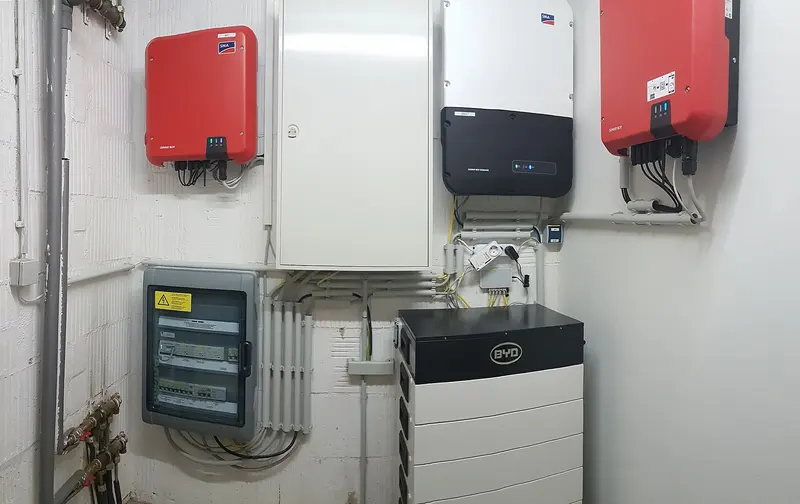
What a battery does
A home battery stores electricity to use later — spare solar from the day, or cheaper electricity from the grid at off-peak times. It can be fitted with new panels, added to an existing system, or installed on its own.
Costs and size
The Energy Saving Trust (EST) says:
- a typical home battery might be about 10 kWh
- prices range from £1,500 to £10,000, and a 5 kWh battery costs about £4,600
- fitting one at the same time as panels can save money
- batteries typically last 10–12 years — less than panels
Installed home batteries have qualified for 0% VAT since 1 February 2024, including batteries added to existing solar and standalone batteries. The zero rate runs until 31 March 2027.
How much difference it makes
MCS guidance (MGD 003) shows how a battery raises the share of your solar that you use yourself. For a home using 2,500–2,999 kWh a year with about 3,700 kWh of solar:
- No battery: 14–23% of the solar used at home
- About 5 kWh usable: 48–54%
- About 10 kWh usable: 58–60%
(The range depends on whether someone is home all day, half the day or out all day.)
Storing electricity loses a little energy compared with using it directly, and batteries usually stop discharging at a set level, such as 20%, to protect their life.
Is it worth it?
EST says the savings from a battery "won't always be enough on their own to justify the cost". It may save more if you also have a heat pump, or use a time-of-use tariff to charge cheaply — for example, Octopus's Prime Outgoing export tariff pays more between 4pm and 7pm.
Use our savings estimator with and without a battery to compare.
Paying for it
The government's Warm Homes Loan Scheme treats batteries as a separate measure with a loan cap of £15,000, whether standalone or with solar. You must use an MCS-certified installer and product. See grants and loans.
Before you buy
- Get at least three quotes from MCS-certified installers.
- Ask for the battery's usable capacity (not just its nominal size) and its warranty.
- Ask for the installer's self-use estimate with and without the battery.
- If you have plug-in solar, note that current rules don't allow its output to be stored in a battery.
Sources
- Energy Saving Trust: Battery storage
- MCS: MGD 003 Solar PV self-consumption guidance
- HMRC VAT Notice 708/6: Energy-saving materials and heating equipment
- Octopus Energy: Outgoing Octopus export tariffs
- DESNZ: Warm Homes Loan Scheme – scheme rules (Sept 2026)
- Citizens Advice: Six things to know before plug-in solar panels hit UK shelves
This guide is general information, not financial or legal advice. Rules and prices change, and some differ between England, Wales, Scotland and Northern Ireland — check the sources for your situation.