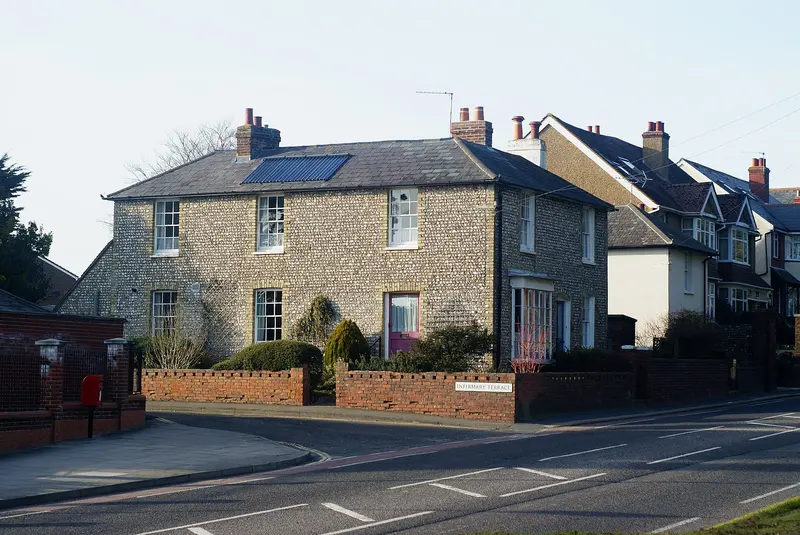
The short answer
Most rooftop solar on houses is permitted development — you don't need to apply for planning permission, as long as size limits and conditions are met. The main exceptions are listed buildings and some installations in conservation areas and World Heritage Sites. Councils can also remove permitted development rights in some places with an "Article 4 direction", so always check with your council.
England (rules rewritten from 27 August 2026)
Panels on a house are permitted development unless:
- on a pitched roof, they stick out more than 0.2 m, or rise above the highest part of the roof (not counting chimneys)
- on a flat roof, they rise more than 0.6 m above the highest part of the roof
- on a wall, they stick out more than 0.2 m on a wall facing a road, or 0.4 m on other walls (the same limits apply to balcony and roof enclosures)
- in a conservation area or World Heritage Site, they go on a wall, balcony or enclosure that faces a road
- the house is listed (including buildings within its grounds), or the site is a scheduled monument
- plug-in solar would be fixed to a wooden wall, balcony, enclosure or timber cladding
Panels should be sited to minimise their effect on the building's appearance and the area, and removed when no longer needed. On a flat roof in a conservation area, National Park, National Landscape (AONB), the Broads or a World Heritage Site, you need to apply to the council for prior approval of the appearance first.
Blocks of flats now have their own, similar rules.
Ground-mounted (stand-alone) solar in a house's garden: from 27 August 2026 the panels can be up to 4 m high in general, but no more than 2 m within 5 m of the boundary, and no more than 1 m if also in front of the house. The total panel area can't exceed 9 m². In a conservation area there are tighter limits and prior approval may be needed.
Scotland
Since 24 May 2024, panels on a house are permitted development unless they stick out more than 1 m from the wall, roof, ridge or chimney; the house is listed or in a World Heritage Site; or, in a conservation area, they go on the front of the house or a side facing a road. Outbuildings have a 500 mm limit and exclude front gardens. For ground-mounted solar at a house, check with your council.
Wales
Panels on a house or outbuilding are permitted development unless, for example, they stick out more than 20 cm on a wall or pitched roof or rise above the roof; on a flat roof they are within 1 m of the edge or stick out more than 1 m; or, in a conservation area or World Heritage Site, they go on a wall facing a road. Stand-alone panels are limited to one array, 4 m high and 9 m², with extra limits near boundaries. Check with your council, as the rules may have been updated.
Northern Ireland
Roof panels are permitted development unless, for example, they stick out more than 20 cm on a roof slope that faces and can be seen from a road, rise above the ridge or more than 1.5 m above a flat roof, or extend beyond the roof edge. Stand-alone panels are limited to one array of 14 m², 2 m high, and not nearer the road than the house. Conservation areas and World Heritage Sites have extra limits.
Listed buildings
Permitted development doesn't apply to listed buildings, so you'll normally need planning permission and separate listed building consent. Talk to your council's conservation officer first.
Flats, leasehold and renting
Even where planning permission isn't needed, leaseholders and tenants need the freeholder's or landlord's permission. See solar for renters and flats.
Other permissions
Your installer should also handle building regulations sign-off for the electrical work and tell or apply to your network operator — ask for the certificates. Businesses: see solar for businesses.
Sources
- legislation.gov.uk: GPDO 2015 (England) Schedule 2 Part 14
- legislation.gov.uk: GPDO (Scotland) Amendment Order 2024 (SSI 2024/102)
- legislation.gov.uk: GPDO (Amendment) (Wales) Order 2012
- legislation.gov.uk: Planning (General Permitted Development) Order (NI) 2015
- legislation.gov.uk: Planning (Listed Buildings and Conservation Areas) Act 1990 s.7
- ENA: Distributed Generation Connection Guide – G98 single premises
This guide is general information, not financial or legal advice. Rules and prices change, and some differ between England, Wales, Scotland and Northern Ireland — check the sources for your situation.