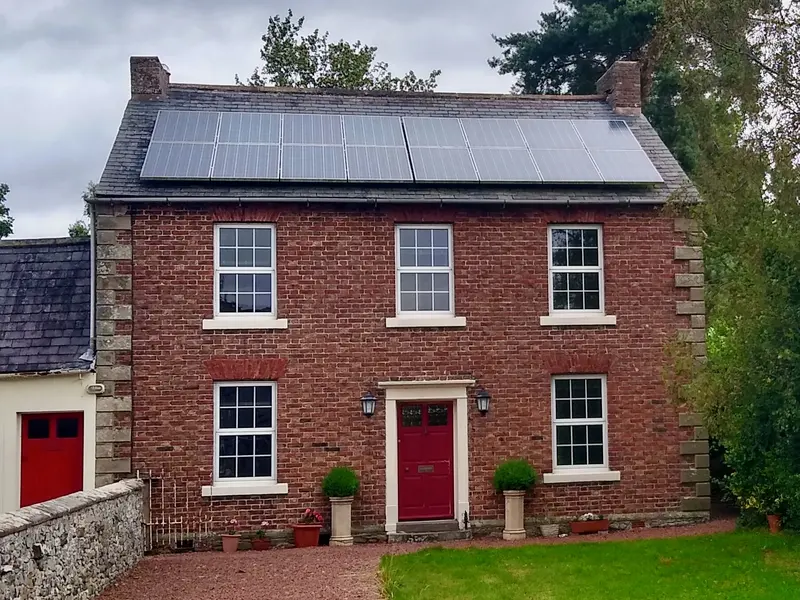
How it works
Solar panels turn daylight into direct-current (DC) electricity, and an inverter turns that into the alternating current (AC) your home uses. Panels work best in direct sun on an unshaded, south-facing roof, but they still make some electricity on cloudy days.
Anything you use while the panels are generating comes from them first. What you don't use is exported to the grid, where you can be paid for it, or stored in a battery if you have one.
What the numbers say
- Cost: the Energy Saving Trust (EST) says home systems are generally around 4.5 kWp and cost around £7,600. Government figures for 2025/26 put the median price at £1,595 per kW for systems up to 4 kW. See how much solar panels cost.
- Payback: EST's estimates for a typical system, including export payments and at July 2026 fuel prices, range from 9 years (London) to 11–12 years (Stirling), depending on where you live and how much you're at home.
- Savings: the government says rooftop solar can save households up to £480 a year.
- Carbon: EST says a typical home system could save around one tonne of CO2 a year, depending on where you live.
- Lifespan: EST says panels should last 25 years or more, though an inverter usually needs replacing after about 12 years.
What makes it more worthwhile
- A roof facing south, south-east or south-west, with little shade. East- and west-facing roofs make about 80% as much as a south-facing one at a typical pitch.
- Using more of your solar electricity yourself, for example by running appliances in the day. Each unit you use saves you the full unit rate; each unit you export earns the (usually lower) export rate.
- A good export tariff under the Smart Export Guarantee (Great Britain only).
- Fitting a battery at the same time, if the sums work for you — see batteries.
Changes in 2026 to know about
- 0% VAT on solar panels and batteries installed in homes runs until 31 March 2027, when it is due to return to 5%. See VAT on solar.
- VAT on household electricity in Great Britain is 0% from 1 October 2026 to 31 March 2027 (it was 5%). That makes each unit of solar you use yourself worth slightly less than before, in pounds.
- Plug-in solar kits of up to 800 W have been legal in Great Britain since 27 August 2026 — an option if you can't fit roof panels. See plug-in solar.
- Warm Homes Loans with reduced interest rates for solar and batteries began their consumer phase from September 2026. See grants and loans.
Try your own figures
Our savings estimator uses the same method MCS installers use for generation, with your postcode zone, roof, electricity use and prices. Then get at least three written quotes from MCS-certified installers — our quotes checklist shows what to compare.
Sources
- Energy Saving Trust: Solar panels
- DESNZ: Solar PV cost data
- GOV.UK: Households can save as plug-in solar panels come to market
- MCS: Irradiance Datasets (kWh/kWp by postcode zone)
- HMRC VAT Notice 708/6: Energy-saving materials and heating equipment
- HMRC Brief 10 (2026): Temporary zero rate of VAT for domestic electricity in GB
- DESNZ: Warm Homes Loan Scheme – scheme rules (Sept 2026)
This guide is general information, not financial or legal advice. Rules and prices change, and some differ between England, Wales, Scotland and Northern Ireland — check the sources for your situation.